
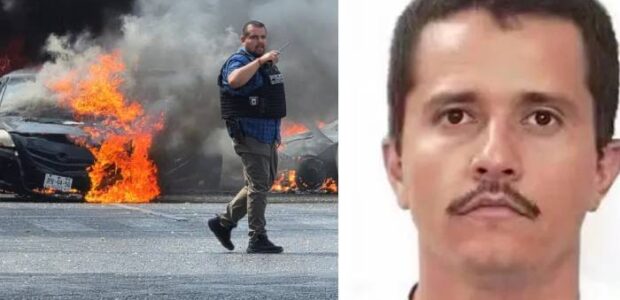
Who Was El Mencho?
Nemesio Rubén Oseguera Cervantes — better known as “El Mencho” — was the long-time leader of the Cártel de Jalisco Nueva Generación (CJNG), one of Mexico’s most powerful and violent drug trafficking organizations. He had been on international most-wanted lists for drug trafficking, violence, and organized crime for years, with a $15 million U.S. bounty on his head for information leading to his capture.
The CJNG under his leadership became infamous for trafficking fentanyl, cocaine, methamphetamine, and heroin, and for expanding aggressively across Mexico and into the United States. It was so influential that the U.S. classified it as a foreign terrorist organization in 2025.
🪖 The Military Operation That Changed the Drug War
In late February 2026, Mexican security forces launched a major military operation in the mountains of Tapalpa, Jalisco, aimed at capturing El Mencho. The operation — backed with intelligence support from U.S. agencies — led to a fierce shootout and ultimately to the death of El Mencho and six CJNG members.
According to official statements:
-
El Mencho was wounded during the operation and died while being transported to Mexico City.
-
Several Mexican soldiers were wounded but survived.
-
The operation was described as one of the most significant blows against cartel leadership in Mexico’s recent history.
🔥 Immediate Aftermath: Violence and Chaos
The news of his death triggered a wave of violent retaliation by CJNG members and allied groups across Mexico:
-
Massive violence erupted in multiple states including Jalisco, Guanajuato, Michoacán, Tamaulipas, and others.
-
Roads were blocked with burned vehicles, petrol stations and businesses were attacked, and armed confrontations broke out with security forces.
-
Reports say at least 70 people — including cartel members, security personnel, and civilians — died in clashes.
-
The Mexican government deployed thousands of additional troops, including the National Guard and army, to restore order across affected regions.
Authorities also reported that initial narco-blockades have been lifted and security has been gradually restored in most hotspot areas, but isolated clashes and tensions remain.
🌎 Political and Security Implications
The killing and aftermath have sparked discussion on both sides of the border:
Government Responses
-
Mexican President Claudia Sheinbaum praised the operation, calling it a demonstration of the government’s strengthened security capabilities, and emphasized calm and continued cooperation with U.S. counterparts.
-
U.S. officials also acknowledged the role of shared intelligence in locating El Mencho, highlighting cross-border cooperation.
Public Safety Concerns
-
The violence raised short-term concerns, including school closures and travel advisories in some states, though authorities urged residents and visitors not to panic.
-
With major global events such as the upcoming World Cup, Mexican officials stressed that security measures are being enforced nationwide.
📈 What This Means for the Drug War
Leadership Vacuum in CJNG
With the death of El Mencho, analysts warn that:
-
Power struggles could emerge within CJNG as factions vie for leadership.
-
Violence might increase before it subsides as rival cartels attempt to exploit the instability.
-
Cartel recruitment and trafficking networks remain deeply entrenched despite the removal of a top leader.
Strategic Impact
Experts also note that while eliminating a top kingpin is symbolically significant, it doesn’t automatically dismantle the cartel or stop drug flows; similar outcomes were seen after El Chapo’s capture.
🧠 Big Picture: Continuing the Fight
The operation marks a milestone event in the Mexican drug war, but experts say the conflict is far from over:
-
Cartels still control vast territories and maintain logistical networks.
-
Social, economic, and institutional factors that fuel organized crime remain persistent.
-
Long-term strategies will require cooperation between governments, intelligence sharing, and efforts to reduce recruitment and violence beyond military actions.